A dish you can only truly eat in Hoi An
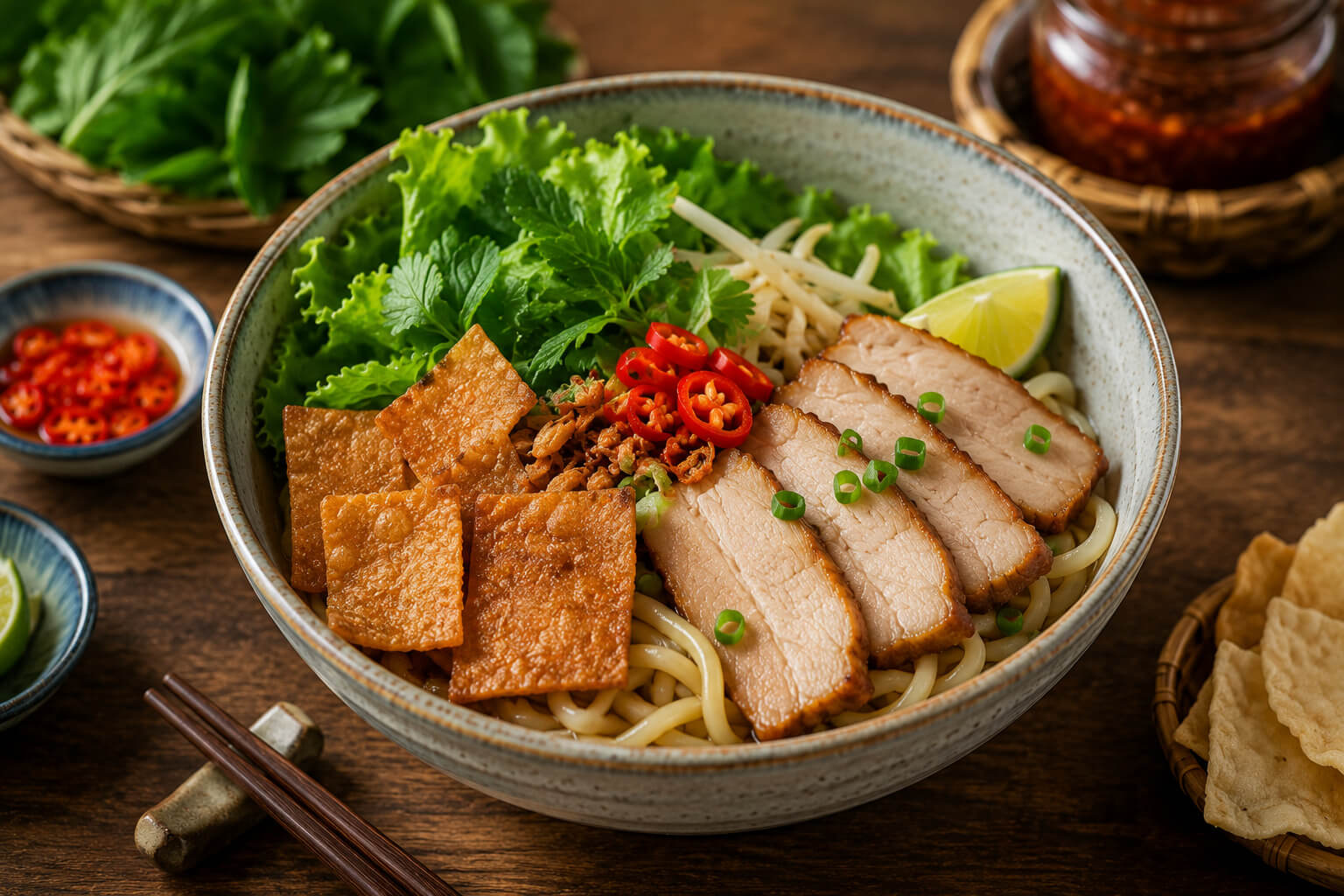
Cao lầu is Hoi An’s singular, irreplaceable noodle dish — and one of the most geographically specific foods on earth. Thick, chewy, slightly smoky noodles (made using water drawn from the ancient Bà Lễ Well and wood ash lye) are topped with slices of Chinese-style roast pork (xá xíu / char siu), crispy puffed rice crackers (bánh đa), fresh bean sprouts, saw-tooth coriander and mint, all bound together with a small amount of concentrated pork sauce. This is a dry noodle dish — there is no soup broth, just a rich, glossy dressing.
What makes cao lầu truly unique — and unreproducible elsewhere — is the noodle itself. The dough is made with water exclusively from the Bà Lễ Well in Hoi An’s ancient town, combined with ash made from burning specific trees sourced from the Cử Lao Chàm islands. This ash lye gives the noodles their distinctive yellowish-grey colour, firm chewy texture and slightly smoky, earthy flavour. The same noodles made with any other water taste different — and noodle-makers know it. This is why “cao lầu” served in restaurants elsewhere in Vietnam is, by definition, an imitation.
The dish carries the culinary DNA of three cultures: the thick chewy noodle style echoes Japanese udon (brought by Japanese traders who made Hoi An a major port in the 16th–17th centuries); the char siu pork topping reflects the influence of Chinese merchants who also settled in Hoi An; and the fresh herb plate and fish sauce seasoning are unmistakably Vietnamese. No other single dish in Vietnam carries this breadth of cultural heritage in a single bowl.
Cao lầu is believed to have emerged during Hoi An’s golden age as a Southeast Asian trading hub in the 16th–17th centuries, when Japanese, Chinese and Vietnamese cultures intersected in the ancient port town. The dish synthesises Japanese noodle technique, Chinese char siu pork and Vietnamese herb traditions into something wholly its own. Its dependence on local well water and island-sourced ash has kept it rooted in Hoi An for centuries.
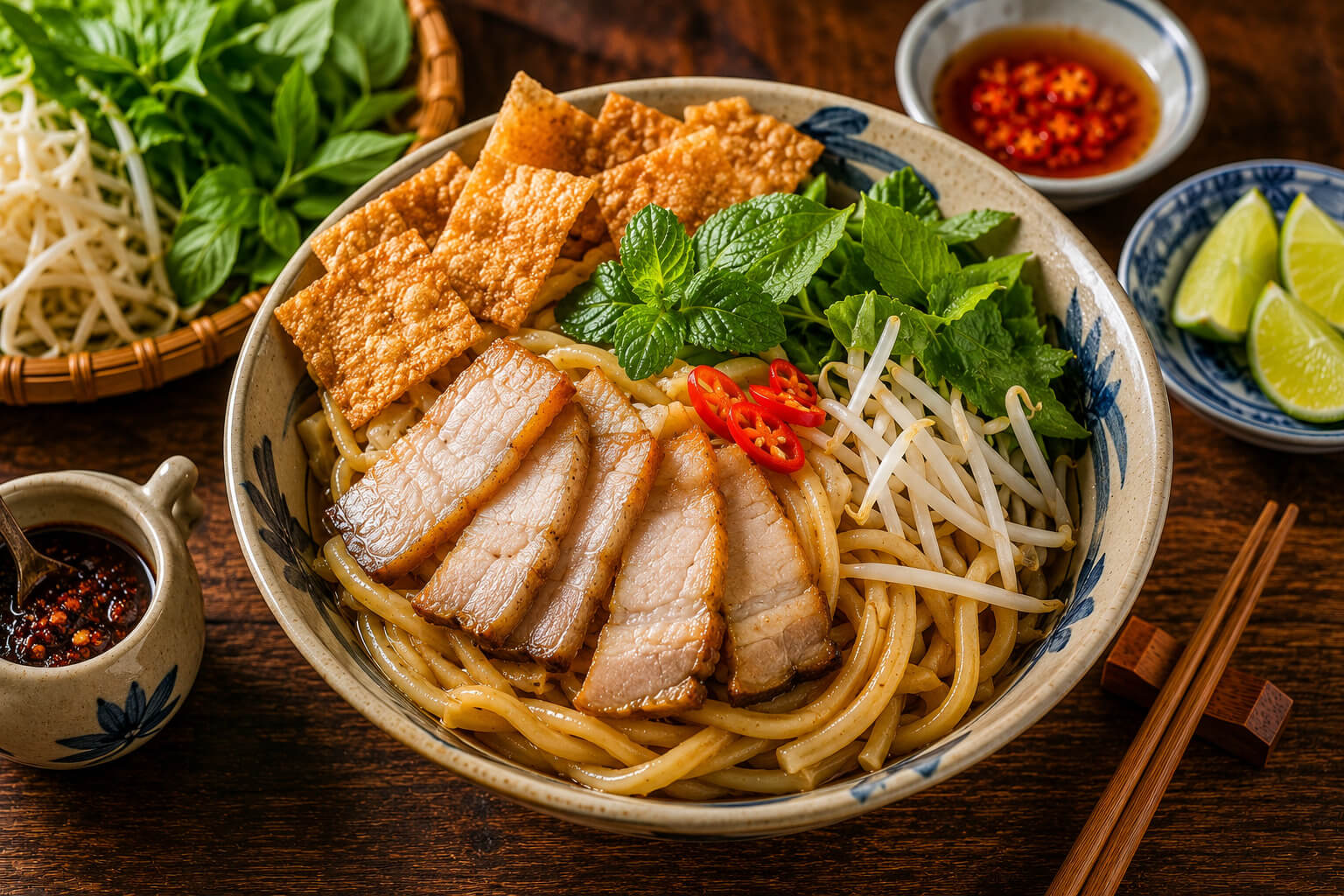
Cao Lầu Hội An
The one true version. Made with Bà Lễ Well water and Cử Lao Chàm island ash lye, the noodles have their characteristic yellow-grey colour, firm bite and smoky flavour. Topped with xá xíu char siu pork, tóp mỡ (crispy pork rind), bánh đa rice crackers and fresh herbs. The sauce is a reduced pork cooking liquid — concentrated and deeply savoury. Any version served outside Hoi An using different water and ash is a well-intentioned approximation, not the real thing.
Thick rice-flour noodles made with Bà Lễ Well water and wood-ash lye — grey-yellow, chewy, slightly smoky
Xá xíu — Chinese-style char siu roast pork with a caramelised, five-spice crust
Bánh đa — flat crispy rice crackers, puffed and toasted, added on top for crunch
Tóp mỡ — crispy rendered pork rind, adding fat and crunch
Reduced pork cooking sauce — concentrated, savoury, with soy and five-spice notes; used sparingly
Trung Bắc Restaurant
📍 87 Trần Phú, Hội An Ancient Town
One of the oldest and most traditional cao lầu restaurants in Hoi An. Long-running family operation, consistently good quality. Located on the main heritage street — easy to combine with sightseeing. Busy at lunch; arrive by noon.
Cao Lầu Bà Bé
📍 Near Hội An Central Market (Chợ Hội An), Hội An
A beloved market-adjacent stall known among Hoi An locals as one of the most authentic preparations. Small, informal, very cheap. The noodles are made fresh daily and the char siu pork is roasted in-house. Cash only.
Morning Glory Restaurant
📍 106 Nguyễn Thái Học, Hội An Ancient Town
A well-regarded upscale restaurant run by chef Vư Thị Hiềp — author of several Vietnamese cookbooks. The cao lầu is consistently excellent, made to traditional standards. Good for travellers who want a slightly more comfortable setting. English menu, air-conditioned.
| Venue Type | VND | USD (approx.) | INR (approx.) |
|---|---|---|---|
| Market stall / street vendor in Hoi An | 40,000–55,000 | $1.60–$2.20 | ₹140–182 |
| Local restaurant in Hoi An | 55,000–75,000 | $2.20–$3.00 | ₹182–247 |
| Upscale / tourist restaurant in Hoi An | 75,000–110,000 | $3.00–$4.40 | ₹247–363 |
A vegetarian version can occasionally be found at Hoi An vegetarian restaurants — tofu replaces the char siu pork and a soy-based sauce substitutes for the pork reduction. However, the dish loses a significant part of its character without the roast pork. The noodles themselves remain the same (vegetarian-friendly in their base ingredients).
"Cho tôi cao lầu chay" — I’d like vegetarian cao lầu (limited availability)Vegan note: Unlikely at most restaurants — the sauce typically contains fish sauce. At a dedicated vegan restaurant, it can be adapted.
Jain note: Standard cao lầu contains pork and fish sauce. The chay version may use soy sauce (confirm) and may still include garlic and spring onion. Jain travellers should seek a dedicated Buddhist vegetarian restaurant in Hoi An where allium-free cooking is standard practice.
The noodles require two ingredients found only in Hoi An: water from the Bà Lễ Well (a Cham-era well with specific mineral content) and ash from trees grown on the Cử Lao Chàm islands. This ash is dissolved in water to create a lye solution that gives the noodles their distinctive colour, texture and flavour. The same noodle dough made with any other water and ash produces a fundamentally different result.
The Bà Lễ Well (or Giếng Bà Lễ) is an ancient well in Hoi An’s ancient town, believed to date back to the Cham civilisation over 1,000 years ago. The water has a specific mineral composition — particularly its calcium content — that affects how the cao lầu noodle dough behaves and tastes. Noodle makers still draw water from this well today. The well is a tourist attraction in its own right at 35 Phan Châu Trinh.
The thick, chewy noodle style of cao lầu bears a strong resemblance to Japanese udon noodles. Hoi An was a major trading port in the 16th–17th centuries with a thriving Japanese merchant community — the Japanese Bridge (Chùa Cầu) is a UNESCO heritage landmark from this period. Food historians believe the Japanese traders brought their noodle-making techniques to Hoi An, which local cooks adapted using local water and ingredients. The char siu pork topping reflects simultaneous Chinese merchant influence.
No — this is a common misconception. Cao lầu is a dry noodle dish, not a soup. There is no broth. The noodles, pork and crackers are bound with a small amount of concentrated sauce. Do not add water or extra liquid — this will dilute the flavour and make the crackers soggy.
Those are bánh đa — flat rice crackers that are puffed and toasted until crispy. They add a crucial textural contrast to the chewy noodles and silky pork. Eat quickly before they soften — they are at their best in the first few minutes after the dish is assembled.
Standard cao lầu is built around char siu pork — removing it leaves a largely uninteresting bowl of noodles. A tofu substitution is occasionally available at vegetarian restaurants but is a significantly different dish. This is one Vietnamese noodle dish where the pork is genuinely central to the experience, not just an add-on.
The noodles are made from rice flour — technically rice-based. However, the ash lye process adds complexity and the gluten-free status is debated among coeliac communities. The sauce may contain soy sauce (wheat). If you are coeliac, treat it with caution and confirm ingredients at each restaurant.
Hoi An’s cuisine as a whole — including cao lầu, bánh mì and com gà — is recognised as part of the UNESCO World Heritage cultural landscape of Hoi An Ancient Town. Cao lầu specifically is frequently cited by international food authorities as one of the world’s most geographically unique dishes.
Yes — several cooking schools in Hoi An (including Morning Glory Cooking School) offer classes that include cao lầu. However, the noodles used in classes are sometimes commercially made (using well water in larger batches). The class experience is excellent and gives deep insight into the dish even if the noodle-making itself is simplified.
Approximately “cow loh” — “cao” rhymes with “cow”, “lầu” sounds like “loh” with a slight dipping tone. The full phrase said as “cow loh” is recognisable everywhere in Hoi An. Locals will immediately know what you’re asking for.
Our specialists plan food-focused itineraries around what you want to eat.
Plan My Food Trip