The most delicate thing you'll eat in Hanoi.
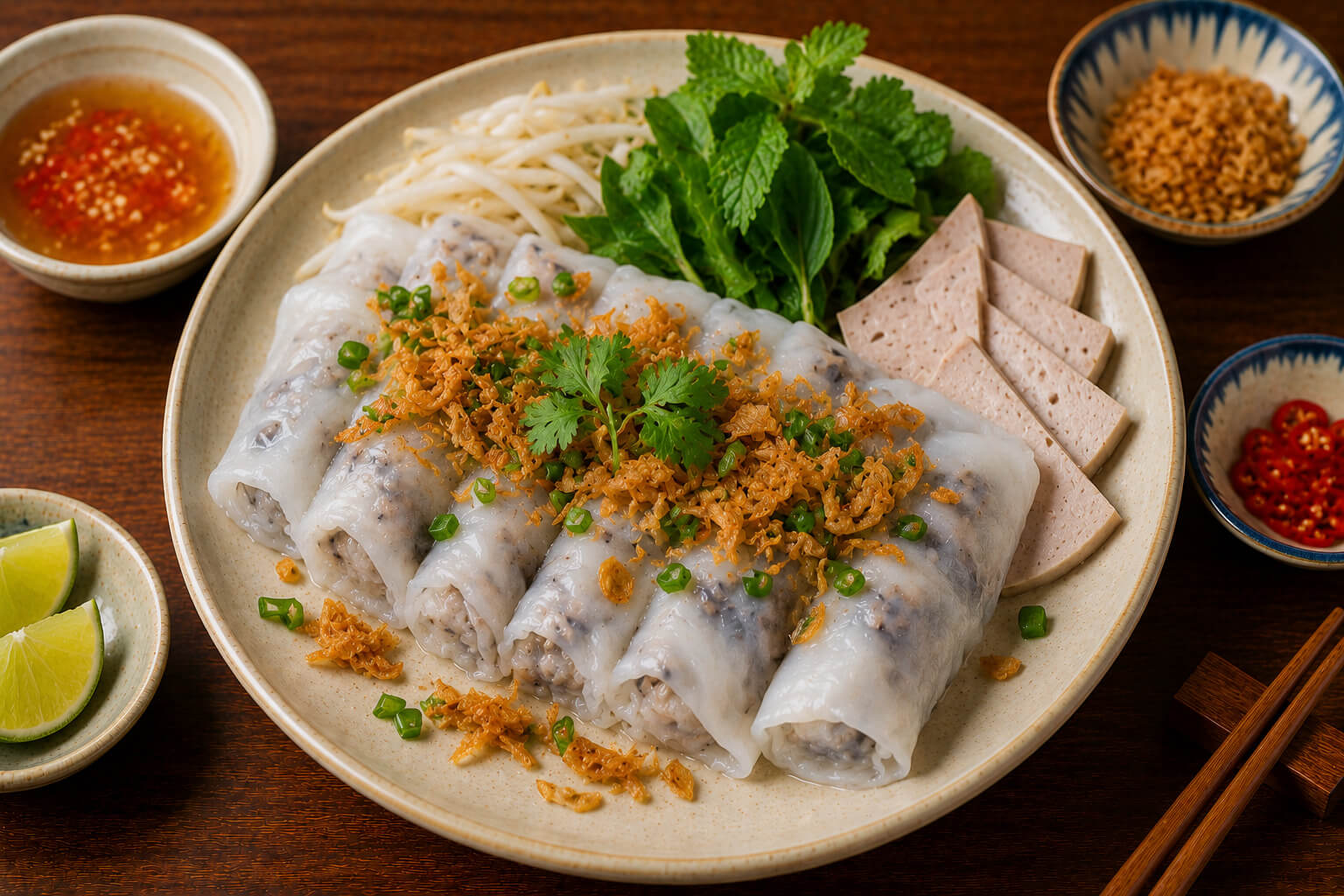
Bánh Cuốn is one of the most technically demanding street foods in Vietnam and one of the most beautiful — a paper-thin sheet of silky, almost translucent rice batter steamed on a cloth stretched over boiling water, rolled in seconds around a filling of minced pork and wood-ear mushrooms, and served with crispy fried shallots drizzled over the top.
The batter is made from rice flour and tapioca starch mixed with water to a whisper-thin consistency. The cook ladles a small amount onto the cloth, spreads it into a perfect circle in one motion, closes the lid for 20–30 seconds, then peels the gossamer sheet off with a long flat tool and folds it around the filling in a single practised movement. Done well, the sheet is so thin you can see through it — and achieving this takes years of practice. The filled rolls are topped with golden crispy fried shallots and a drizzle of shallot oil, and served alongside chả lụa (Vietnamese steamed pork sausage) and a bowl of nước chấm dipping sauce.
For Indian visitors, the closest reference point is a very delicate rice crepe — thinner than a Kerala appam and softer than a pesarattu — folded rather than cooked flat. The texture is unique: yielding, slippery, and extraordinarily delicate, with a faint rice fragrance. The flavour is subtle and gentle, and the shallot oil is the element that brings it alive. Watching the cook make bánh cuốn at a traditional stall is as much a performance as a meal — the cloth-steaming technique is one of the most distinctive culinary traditions in Southeast Asia.
Bánh cuốn is believed to have originated in northern Vietnam, with the province of Cào Bằng often cited as the birthplace of the cloth-steaming technique. It migrated to Hanoi and became one of the most beloved morning foods in the capital. The dish has remained essentially unchanged for centuries.

Bánh Cuốn Hà Nội
The definitive version — ultra-thin translucent rice sheets, minced pork and wood-ear mushroom filling, golden fried shallots, shallot oil, chả lụa sausage, and nước chấm. Served at breakfast only at specialist stalls.

Bánh Cuốn Cào Bằng
Believed to be the original form. The wrappers are slightly thicker, filled with more pork and mushroom. Served with cây chùa (pickled mustard greens) and a different dipping sauce. Less refined but deeply flavourful.

Bánh Cuốn Sài Gòn
Southern versions are thicker-wrapped and often served dry without dipping sauce — instead eaten with soy sauce or a different condiment. Bean sprouts and more herbs are common additions. A heartier, more substantial take.
Rice flour and tapioca starch mixed with water — very thin, almost translucent when cooked
Minced pork, finely seasoned with fish sauce, pepper, and sugar
Dried wood-ear mushrooms (mộc nhĩ), rehydrated and finely chopped
Crispy golden fried shallots and shallot oil — the essential finishing element
Chả lụa — steamed Vietnamese pork sausage, sliced; served alongside
Nước chấm dipping sauce: fish sauce, lime, sugar, garlic, chilli — served in a small bowl
Sliced cucumber, fresh herbs, extra chilli
Bánh Cuốn Bà Hành
📍 8 Ngo Si Lien, Ðống Ða, Hà Nội
Widely considered the best bánh cuốn in Hanoi. The same woman has been making rolls at this stall for over 40 years. Tissue-thin wrappers, precise rolling technique. Open only until 11 am. Queue expected.
Bánh Cuốn Thanh Vân
📍 14 Hàng Gà, Hoàn Kiếm, Hà Nội
Old Quarter location — tourist-accessible and consistently high quality. The cloth-steaming is done in the open kitchen where guests can watch. English-speaking owner. Excellent chả lụa.
Bánh Cuốn Giá Gia
📍 38 Tiên Thắng, Hoàn Kiếm, Hà Nội
A well-loved Old Quarter breakfast stall with notably good shallot oil and crispy fried shallot garnish. The rolls are slightly thicker than Ba Hanh's but generous and flavourful. Good for those who want a heartier portion.
Bánh Cuốn Tây Hơ
📍 264 Tô Hiến Thành, Quận 10, TP. Hồ Chí Minh
District 10 specialist in northern-style bánh cuốn — thinner wrappers than the typical HCMC version, with proper cloth-steaming technique. A genuine taste of northern Vietnam in the south.
Bánh Cuốn Sài Gòn Tây Bắc
📍 14 Hong Ha, Quận Tân Bình, TP. Hồ Chí Minh
Popular HCMC spot making the heartier southern version of bánh cuốn — slightly thicker wrappers with more filling. Served with bean sprouts and a richer dipping sauce. Good for those who want a more substantial breakfast.
Bánh Cuốn Bá Lệ
📍 106 Nguyen Thi Minh Khai, Quận 3, TP. Hồ Chí Minh
A District 3 institution with over three decades of operation. Serves both bánh cuốn and bánh ướt (a simpler steamed rice sheet). The fried shallot garnish here is exceptional — deep golden and intensely fragrant.
| Venue Type | VND | USD (approx.) | INR (approx.) |
|---|---|---|---|
| Street cart / market stall | 30,000 — 40,000 | $1.20 — $1.60 | ₹100 — ₹133 |
| Local restaurant | 40,000 — 55,000 | $1.60 — $2.20 | ₹133 — ₹183 |
| Mid-range restaurant | 55,000 — 80,000 | $2.20 — $3.20 | ₹183 — ₹267 |
| Hotel / tourist restaurant | 80,000 — 130,000 | $3.20 — $5.20 | ₹267 — ₹433 |
Two vegetarian options exist: plain bánh cuốn without filling (không nhân) — just the silky rice sheet with shallot oil; or a mushroom-filled version at vegetarian restaurants. The batter itself is naturally vegan. The nước chấm dipping sauce contains fish sauce — replace with soy sauce for a vegetarian version.
"Bánh cuốn chà y" at vegetarian restaurants. At regular stalls: "Bánh cuốn không thịt — nhân nấm thôi" (banh cuon without meat — just mushroom filling).Vegan note: The rice batter is vegan. Shallot oil may use animal fat at some stalls — confirm "Dàu hành dùng dàu thực vật không?" (is the shallot oil vegetable oil?). Request soy sauce instead of fish sauce for the dipping sauce.
Jain note: The rice batter (rice flour, tapioca, water) is entirely Jain-compatible. However, the fried shallots (onion family) are a central element and the filling uses mushrooms cooked with garlic. For strict Jain compliance, request no shallots and confirm no garlic in the mushroom filling — this is possible at specialised vegetarian restaurants but difficult at street stalls.
The cloth-steaming technique produces an extraordinarily thin, silky, and delicate sheet that cannot be replicated by other methods. The rice sheet is almost translucent and has a unique tender-yielding texture unlike any other noodle or wrapper in Vietnamese cuisine.
Yes — the batter is made from rice flour and tapioca starch, both naturally gluten-free. Bánh cuốn is one of the best gluten-free breakfast options in Vietnam. Confirm the dipping sauce does not use soy sauce containing wheat.
A finely woven cloth (vải) stretched tightly over a pot of boiling water. The batter is ladled and spread on this cloth, the steam from below cooks it instantly into a thin sheet. This technique is unique to Vietnamese bánh cuốn and a few related regional specialities.
Chả lụa is Vietnamese steamed pork sausage — made from ground pork, fish sauce, and starch, wrapped in banana leaf and steamed. It is served alongside bánh cuốn as a standard accompaniment. Sliced into rounds, it provides a savoury contrast to the delicate rice rolls.
The batter is made to an extremely thin consistency — far more water than flour. When spread on the cloth and steamed, it sets into a translucent sheet. The skill is in spreading it evenly without holes. The translucency is a quality indicator.
The home version uses a non-stick pan to simulate the cloth, but the result is thicker and less delicate. The true cloth-steamed technique requires practice and the right equipment. Many Vietnamese families make a simpler version — called bánh ướt — which is essentially the same batter cooked in a pan.
Traditional bánh cuốn is specifically a morning dish and most specialist stalls close before noon. Some restaurants offer it at lunch; evening availability is rare. If you see it on a dinner menu, it will usually be a simpler, less authentic version.
The filling is minced pork lightly seasoned with fish sauce, white pepper, and sugar, mixed with finely chopped wood-ear mushrooms (mộc nhĩ). It is subtle — not strongly flavoured — designed to complement rather than compete with the delicate rice sheet.
Bánh cuốn has a thinner, softer wrapper than dim sum har gow and is less compact than siu mai. It is also served flat and rolled rather than folded into a dumpling shape. The cooking method (steam-on-cloth) produces a different texture from any dim sum preparation.
The rolls are delicate and can tear if handled roughly. Use gentle, confident chopstick movements. Picking up from the end and dipping into the sauce is the standard technique. If you prefer, a spoon and fork work fine — no judgement from Vietnamese diners.
Our specialists plan food-focused itineraries around what you want to eat.
Plan My Food Trip