Crunchy, tangy, addictive — Vietnam's most refreshing salad.
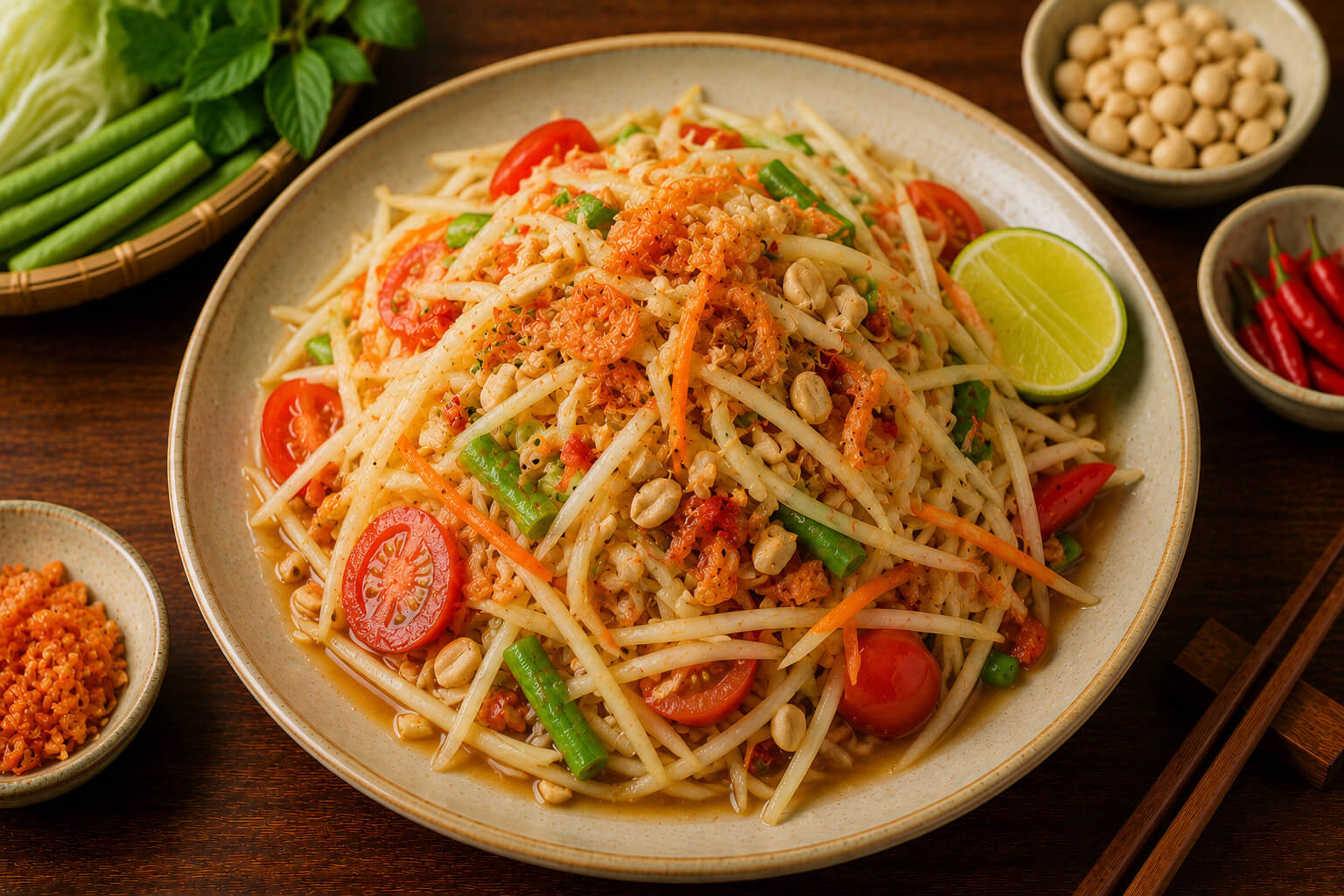
Gỏi Ðu Ðủ is Vietnam's vibrant green papaya salad — shredded unripe papaya tossed with a punchy lime-fish sauce-chilli dressing and topped with shredded dried beef jerky, Vietnamese basil, fried shallots, and generously crushed roasted peanuts. It is crunchy, tangy, aromatic, and completely addictive.
The key ingredient is xanh — unripe, green papaya (đu đủ xanh). At this stage the fruit is not yet sweet and its flesh is firm, crisp, and almost neutral in flavour — a perfect blank canvas for the powerful dressing. The papaya is peeled and julienned into long, fine strands, then tossed with the dressing of fish sauce, lime juice, sugar, garlic, and chilli until lightly wilted but still retaining a satisfying crunch. The bò khô (dried seasoned beef jerky) on top provides a chewy, intensely savoury contrast. Vietnamese basil (húng quế) contributes a sweet anise note, and the peanuts add a final crunch and nuttiness that rounds out the texture.
Vietnamese green papaya salad is lighter and fresher than the better-known Lao and Thai versions. It uses less chilli, a more restrained dressing, and relies on the papaya's texture rather than soaking it into softness. For Indian visitors, this is one of the most immediately approachable Vietnamese dishes — the flavour profile of tamarind-lime-chilli-peanut is deeply familiar from South and West Indian cuisines, and the raw vegetable crunch mirrors many Indian salads (kachumber, raw papaya chutney). It is also one of the dishes where Indian visitors most commonly say "I could eat this every day."
Green papaya salads are a shared tradition across mainland Southeast Asia — Vietnamese gỏi đu đủ shares roots with Thai som tum and Lao tum mak hoong but developed its own distinct character through different seasoning traditions and the availability of specific local ingredients.

Gỏi Ðu Ðủ Bò Khô
The definitive southern version — shredded green papaya with dried beef jerky (bò khô), Vietnamese basil, fried shallots, roasted peanuts, and a lime-fish sauce-chilli dressing. The bò khô is the essential differentiator.

Gỏi Ðu Ðủ Tôm Khô (Dried Shrimp)
Some versions substitute dried shrimp for beef jerky, creating a lighter but more pungent dressing. The dried shrimp are mixed directly into the dressing rather than placed on top.

Gỏi Ðu Ðủ Huế
Central Vietnamese versions tend to be spicier, with more chilli and less sugar in the dressing. Some add thin slices of pork skin. The papaya is shredded more finely.
Green (unripe) papaya — peeled, seeded, julienned into fine matchstick strips
Bò khô — dried seasoned Vietnamese beef jerky, shredded (chewy, intensely savoury)
Vietnamese basil (húng quế) — sweet and slightly anise-scented, different from Italian basil
Roasted peanuts, crushed coarsely
Crispy fried shallots in shallot oil
Fish sauce (nước mắm), fresh lime juice, sugar, water, minced garlic, sliced fresh chilli
Dried shrimp (tôm khô), sliced chilli garnish, extra lime wedge
Quán Gỏi Hoa Quả Thanh Xuân
📍 22 Hàng Ðào, Hoàn Kiếm, Hà Nội
Old Quarter stall selling various Vietnamese salads including green papaya. The dressing here is slightly northern in style — less sweet, more sour. Good peanut garnish. Popular with locals for a quick lunch snack.
Gỏi Búa
📍 28 Ngõ Trạch, Ðống Ða, Hà Nội
A popular Hanoi Vietnamese salad restaurant. Gỏi đu đủ with bò khô is a staple of the menu. Comfortable seating, consistent quality, and a lively local atmosphere at lunch.
Gỏi Ðu Ðủ Khúc Bạch
📍 5 Lý Quốc Sư, Hoàn Kiếm, Hà Nội
A small street stall near Hoan Kiem lake that pairs green papaya salad with chè khúc bạch dessert — a popular Hanoi afternoon snack combination. Very affordable and authentically local.
Gỏi Ðu Ðủ Bò Khô Bà Sáu
📍 9 Phan Xich Long, Phú Nhuận, TP. Hồ Chí Minh
One of HCMC's most respected papaya salad stalls — operating from the same corner for over 20 years. The bò khô is house-made and the dressing is perfectly calibrated. Always busy at lunchtime.
Quán Gỏi Nha Trang
📍 40 Hoàng Diệu, Quận 4, TP. Hồ Chí Minh
District 4 local favourite known for its generous portions and excellent bò khô. Also serves banana blossom salad (gỏi bap chuoi) — order both for a Vietnamese salad comparison.
The Lunch Lady (Hàng Rông)
📍 23 Hoang Dieu, Quận 4, TP. Hồ Chí Minh
Famous HCMC street food vendor who rotates her menu daily. Gỏi đu đủ appears regularly as a side dish. The quality of all her food is exceptional — worth checking her current menu in advance.
| Venue Type | VND | USD (approx.) | INR (approx.) |
|---|---|---|---|
| Street cart / market stall | 30,000 — 40,000 | $1.20 — $1.60 | ₹100 — ₹133 |
| Local restaurant | 40,000 — 55,000 | $1.60 — $2.20 | ₹133 — ₹183 |
| Mid-range restaurant | 55,000 — 80,000 | $2.20 — $3.20 | ₹183 — ₹267 |
| Hotel / tourist restaurant | 80,000 — 130,000 | $3.20 — $5.20 | ₹267 — ₹433 |
Omit the bò khô (dried beef) and dried shrimp, and replace the fish sauce dressing with soy sauce or a vegetarian dipping sauce. The remaining ingredients — green papaya, Vietnamese basil, peanuts, fried shallots — are all plant-based. Available at vegetarian restaurants and on request at most stalls.
"Gỏi đu đủ không thịt, không nước mắm — dùng nước tương" (papaya salad without meat, without fish sauce — use soy sauce).Vegan note: The vegetarian version without fish sauce and dried seafood is vegan. Fried shallots may be cooked in animal fat at some stalls — confirm if this is a concern: "Dàu chiên hành là dàu gì?"
Jain note: Green papaya salad without meat and fish sauce has good Jain-compliance potential. The peanuts, papaya, herbs, and lime dressing are all acceptable. Fried shallots (onion family) would need to be omitted for strict Jain compliance. Ask: "Không hành phi" (no fried shallots). A Jain-friendly version is achievable at dedicated vegetarian restaurants.
Related but distinct. Thai som tum uses a mortar and pestle to pound the papaya, making it softer and more heavily dressed. Vietnamese gỏi đu đủ shreds the papaya into fine julienne without pounding — retaining more crunch. The dressing is also lighter, less pungent, and less spicy.
Green papaya has almost no flavour of its own — it is crunchy, slightly watery, and very mildly vegetal. It acts as a neutral vehicle for the dressing. Unlike ripe papaya, it has no sweetness and no musky fruit aroma.
Bò khô is Vietnamese dried seasoned beef — yes, similar to jerky in concept. It is marinated in soy, lemongrass, chilli, and spices before drying. The texture is chewy and the flavour is intensely savoury and slightly sweet.
Mildly to moderately spicy by default. The chilli level in the dressing can be requested lower ("ít cay" = less spicy) or higher ("cay nhiều" = very spicy). The base salad without extra chilli is approachable for most palates.
Yes — request "không lạc" (no peanuts) when ordering. The salad is complete without them, though the textural contrast is reduced.
In Vietnam it functions as a snack or light meal — eaten on its own in the afternoon or as a starter before rice dishes. It is not typically served as a side to a main course in the way that salads function in Western dining.
The papaya, herbs, and garnishes are raw. The bò khô is a preserved, dried beef product that is safe to eat without additional cooking. The peanuts are roasted. There is no raw meat in the dish.
Ho Chi Minh City and the south. Street salad culture is stronger in the south than in the north — the tropical climate makes fresh, cold salads more appealing year-round. In Hanoi it exists but is less ubiquitous.
Raw papaya is used in Indian cooking as a pickle (kacha papaya achaar) and in some curries, but the Vietnamese version as a salad — dressed and eaten immediately with herbs and peanuts — is distinct. The closest parallel might be raw mango salad preparations from South India or kachumber textures.
Mid-morning to afternoon — it is the ideal between-meal snack in hot weather. Many street vendors specialise specifically in the afternoon trade (around 2–5 pm) when people want something light and cooling.
Our specialists plan food-focused itineraries around what you want to eat.
Plan My Food Trip